
How to Wire a Gigabit Home Network: A Complete Guide to the Socket Cat 6 Wiring Diagram for Wall Plates
Understanding how to establish these physical connections can seem intimidating, but mastering the basics of a socket cat 6 wiring diagram for wall plates simplifies the entire process. By learning how to terminate your own network jacks, you can bypass expensive professional installation fees and build a lightning-fast, future-proof home network.
Whether you are looking to optimize your home office, upgrade your entertainment center, or boost your gaming setup, getting a handle on this foundational networking skill is the first step toward true digital independence.
---

Why Socket Cat 6 Wiring Diagram for Wall Plates Is Gaining Attention in the US
Additionally, the rise of smart home automation and high-bandwidth entertainment has crowded the wireless spectrum. From smart thermostats and security cameras to 4K streaming sticks, the average household router is overwhelmed with wireless requests. Offloading stationary devices—like desktop computers, gaming consoles, and smart TVs—to a wired Cat 6 connection frees up wireless bandwidth for mobile devices.
Consequently, searching for a reliable socket cat 6 wiring diagram for wall plates has become a priority for DIYers. People are realizing that running bulk Ethernet cable and terminating it themselves is not only highly cost-effective but also adds measurable value to their residential properties.
---
How Socket Cat 6 Wiring Diagram for Wall Plates Actually Works
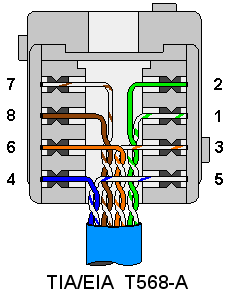
To do this correctly, you must follow a standardized color-coded wiring diagram. The industry recognizes two primary standards for this: T568A and T568B.
The T568A vs. T568B Standards
* T568A Pinout: 1. White/Green 2. Green 3. White/Orange 4. Blue 5. White/Blue 6. Orange 7. White/Brown 8. Brown
* T568B Pinout: 1. White/Orange 2. Orange 3. White/Green 4. Blue 5. White/Blue 6. Green 7. White/Brown 8. Brown
In the United States, T568B is by far the most common standard used for residential and commercial network installations. Whichever standard you choose, the most critical rule is consistency: you must use the exact same standard on both ends of the cable run to avoid creating a crossover cable.

The Termination Process Step-by-Step
First, strip back about an inch of the outer PVC jacket of the Cat 6 cable, taking care not to nick the inner copper conductors.
Next, separate the twisted pairs and arrange them according to the color-coded guide printed directly on the side of your keystone jack.
Place each wire into its corresponding slot on the jack, keeping the twists as close to the termination point as possible to maintain signal integrity.
Finally, use your punch-down tool to press the wires firmly into the metal blades of the jack, which cuts through the plastic insulation to establish a secure electrical connection. Trim any excess wire, snap the jack into your wall plate, and screw the plate onto the wall mounting bracket.
[IMAGE5]---
Common Questions People Have About Socket Cat 6 Wiring Diagram for Wall Plates
Which wiring standard should I choose for my home project?
Do I need a punch-down tool to install a wall plate?
Can I run Cat 6 cables next to electrical wiring?
What happens if I mix up the color codes during installation?
---
Opportunities and Considerations
The Advantages of DIY Installation
Key Challenges to Keep in Mind
---
Things People Often Misunderstand
Another myth is that T568A is inherently superior to T568B. As mentioned earlier, there is absolutely no difference in performance, frequency, or speed between the two configurations. They simply exist as historical standards, with T568B remaining the commercial favorite across North America.
Finally, many beginners believe that they can untwist several inches of the internal wires to make the termination process easier. Doing this is a mistake. The tight twists inside the Cat 6 cable are engineered specifically to block out noise and crosstalk. Untwisting them too far can degrade your connection from Gigabit speeds down to standard Megabit performance.
---
Who Socket Cat 6 Wiring Diagram for Wall Plates May Be Relevant For
* Remote Professionals: Those who rely on uninterrupted video conferencing, massive file uploads, and continuous cloud access for their daily livelihood. * Online Gamers: Players who require the lowest possible ping and zero packet loss during competitive online matches. * Smart Home Enthusiasts: Users building centralized media servers, setting up network-attached storage (NAS) devices, or installing IP security cameras that require Power over Ethernet (PoE). * Property Owners: Landlords and homeowners looking to modernize their properties and increase their long-term market value.
---
Taking the Next Step in Home Networking
Before making any physical modifications to your walls, take the time to practice terminating a few test cables. Familiarizing yourself with the wire colors and the feel of your tools will build your confidence and ensure a clean, professional finish when you begin the actual installation.
---


